Author: Fabio Huwyler

  • „Wer bin ich?“ – Ein Rückblick auf die Tagung zu Neurodivergenz und Geschlechtsidentität

    „Wer bin ich?“ – Ein Rückblick auf die Tagung zu Neurodivergenz und Geschlechtsidentität

    Am 13. März 2026 fand in Zürich eine wegweisende Tagung statt, die sich einer der komplexesten Fragen unserer Zeit widmete: Wie hängen neurobiologische Vielfalt und die Entwicklung der Geschlechtsidentität bei Kindern und Jugendlichen zusammen?. Unter dem Titel „Wer bin ich?“ beleuchteten Expertinnen aus Medizin, Psychologie und Pädagogik die Schnittmengen zweier Spektren, die in der klinischen Praxis und im Alltag immer mehr an Bedeutung gewinnen.

    Neurodiversität: Vielfalt statt Störung

    Der Begriff Neurodiversität beschreibt die natürliche Vielfalt der menschlichen Gehirnentwicklung. Neurodivergente Menschen – dazu gehören etwa Personen im Autismus-Spektrum, mit ADHS, Dyslexie oder Hochbegabung – verarbeiten Informationen anders, als es der gesellschaftlichen „Norm“ entspricht.

    Ein zentrales Anliegen der Tagung war die Entpathologisierung. Das Label „neurodivergent“ soll Betroffene entlasten: Weg vom reinen Störungsdenken, hin zur Akzeptanz neurologischer Merkmale, die oft von aussen nicht sichtbar sind, aber Wahrnehmung und soziale Interaktion tiefgreifend beeinflussen.

    Geschlechtsidentität im Wandel

    Parallel zur neurobiologischen Vielfalt hat sich unser Verständnis von Geschlecht gewandelt. Geschlecht ist ein Spektrum. Während früher Kategorien wie „homosexuell“ oder „transsexuell“ starr besetzt waren, definieren heutige Jugendliche ihre Identität oft aktiv und individuell, etwa als genderqueer, non-binär oder asexuell.

    Dabei ist wichtig zu verstehen:

    • Die Geschlechtsidentität (das innere Wissen, wer man ist) lässt sich nicht von aussen ablesen.
    • Die meisten Menschen entwickeln bereits früh eine Geschlechtskonstanz, doch im Jugendalter nehmen Schwankungen und die Zuordnung zum nicht-binären Spektrum zu.
    • Non-binäre Menschen identifizieren sich nicht oder nur teilweise mit den Kategorien „männlich“ oder „weiblich“.

    Wenn sich die Spektren treffen: Die Schnittmenge

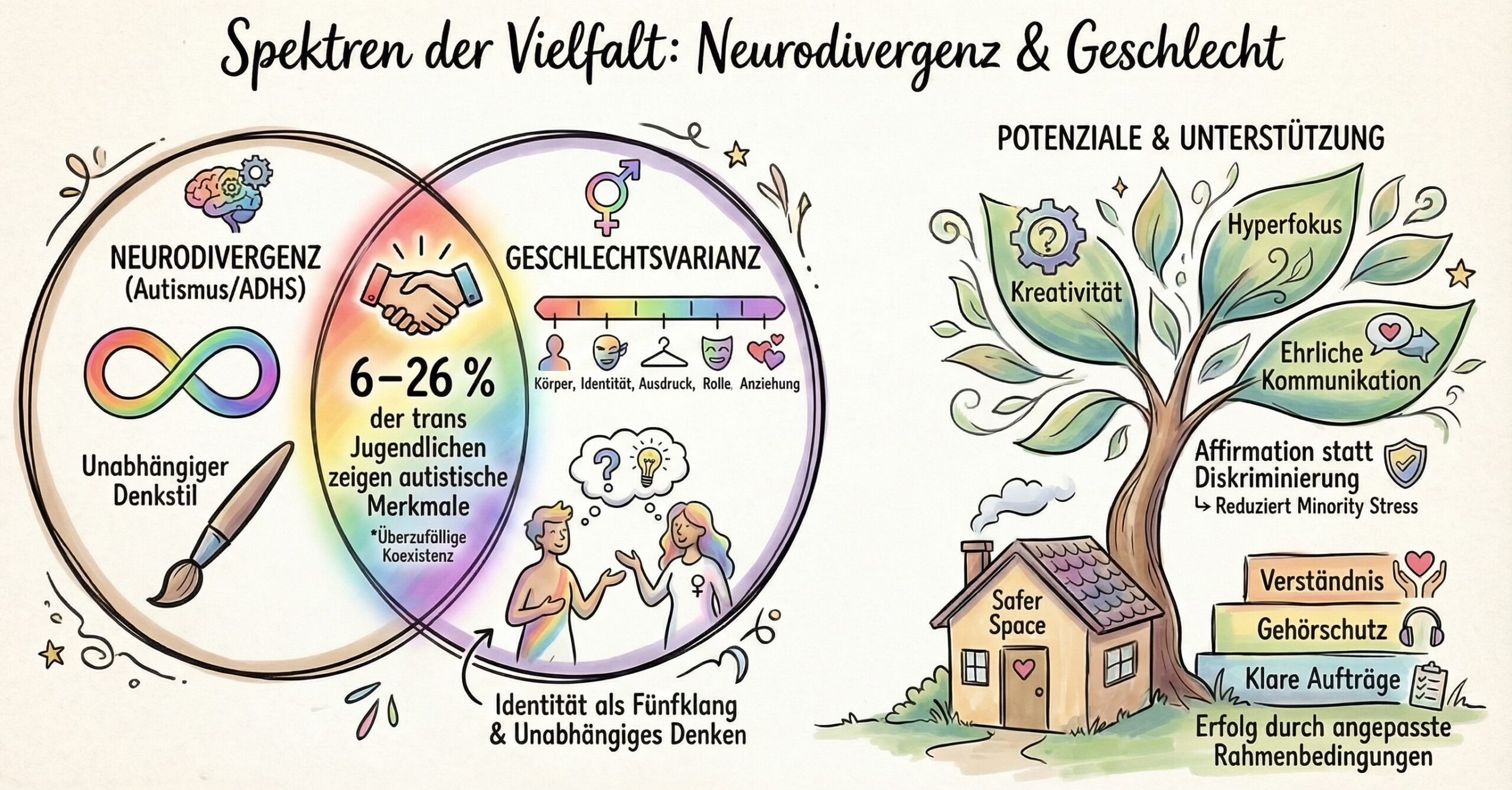
    Ein Schwerpunkt der Tagung war die überzufällige Häufigkeit, mit der Neurodivergenz und Geschlechtsvarianz gemeinsam auftreten. Studien zeigen, dass etwa 9 % bis 11 % der Jugendlichen in Gendersprechstunden eine Autismus-Diagnose haben – ein Vielfaches im Vergleich zur Allgemeinbevölkerung.

    Warum ist das so? Diskutiert werden verschiedene Erklärungsmodelle:

    1. Kognitiver Stil: Autistische Menschen orientieren sich oft weniger an sozialen Normen und hinterfragen Geschlechterrollen daher häufiger kritisch.
    2. Gemeinsame Vulnerabilität: Es könnten überlappende genetische oder neurobiologische Faktoren vorliegen.
    3. Minoritätenstress: Die Interaktion von Neurodivergenz und sozialer Ausgrenzung kann die Identitätsdissonanz verstärken.

    Besondere Herausforderungen und Schutzfaktoren

    Jugendliche, die an dieser Schnittstelle stehen, erleben oft einen doppelten Minoritätenstress. Das Risiko für psychische Belastungen, Angststörungen und Suizidalität ist besorgniserregend hoch. 50-70 % der trans Jugendlichen berichten von Suizidgedanken oder Selbstverletzungen.

    Als protektive Faktoren wurden vor allem eine gute Unterstützung durch die Familie und Peers sowie die soziale Transition (das Leben im Wunschgeschlecht) genannt.

    Was braucht es in der Begleitung?

    Für Fachpersonen und Eltern ergaben sich aus der Tagung klare Handlungsempfehlungen für einen sensiblen Umgang:

    • Ergebnisoffene Haltung: Unterstützung bedeutet nicht, eine Richtung vorzugeben, sondern den Prozess der Identitätsfindung zu validieren und Zeit zu lassen.
    • Anpassung der Kommunikation: Besonders bei autistischen Jugendlichen sind klare Strukturen, Reizreduktion und die Nutzung visueller Hilfsmittel entscheidend.
    • Inklusive Sprache: Die Verwendung der gewünschten Pronomen und Namen ist ein Akt des Respekts und der Sicherheit.
    • Validierung statt Skepsis: Die Sorgen der Eltern müssen ernst genommen werden, ohne dabei die Identität des Kindes zu relativieren.

    Fazit

    Neurodiversität und Geschlechtervielfalt sind keine Modediagnosen, sondern Ausdruck der menschlichen Vielfalt. Die Tagung machte deutlich: Wir müssen lernen, über den Tellerrand binärer Normen hinauszuschauen. Wenn wir Rahmenbedingungen anpassen und Stärken fokussieren, können wir Erfolgserlebnisse generieren und jungen Menschen helfen, ihren Platz in der Gesellschaft zu finden – genau so, wie sie sind.

    Quellen

    Nachfolgend sind die Quellen, die als Grundlage für den Blogbeitrag zur Tagung „Wer bin ich? Neurodivergenz und Geschlechtsidentität im Kinder- und Jugendalter“ (Zürich, 13.03.2026) dienten: 

    • Dr. med. univ. Cornelia Galanda: Neurodivergenz im Kindes- und Jugendalter mit Fokus auf Autismus und ADHS. Stiftung visoparents.
    • KD Dr. med. Dagmar Pauli: Trans, nicht-binär, gender-nonconforming. Was brauchen genderdiverse Kinder und Jugendliche aus medizinisch-therapeutischer Perspektive? Psychiatrische Universitätsklinik Zürich / Stiftung visoparents.
    • Evianne Hübscher: Geschlechtervielfalt – Nonbinarität: Die vielfältigen Dimensionen von Geschlecht. Geschlechter-Radar / Stiftung visoparents.
    • Tanja Schenker: Wenn Neurodivergenz und Geschlechtsvarianz zusammentreffen. Psychiatrische Universitätsklinik Zürich / Stiftung visoparents.

    Diese Unterlagen enthalten zudem zahlreiche Verweise auf internationale Studien (z. B. von Warrier et al., 2020 oder de Vries et al., 2014) sowie medizinische Klassifikationssysteme wie das ICD-11 und DSM-5, die die wissenschaftliche Basis der Tagung bilden.
  • Who am I? – A reflection on the conference on neurodivergence and gender identity

    Who am I? – A reflection on the conference on neurodivergence and gender identity

    On March 13, 2026, a groundbreaking conference took place in Zurich, addressing one of the most complex questions of our time:

    How are neurobiological diversity and the development of gender identity connected in children and adolescents?

    Under the title “Who am I?”, experts from medicine, psychology, and education explored the intersections of two spectra that are becoming increasingly relevant both in clinical practice and in everyday life.

    Neurodiversity: Diversity instead of disorder

    The term neurodiversity describes the natural variation in human brain development. Neurodivergent individuals — including those on the autism spectrum, with ADHD, dyslexia, or giftedness — process information differently from what is considered the societal “norm.”

    A central focus of the conference was depathologization. The label “neurodivergent” is intended to relieve those affected:

    moving away from a purely disorder-based perspective toward the acceptance of neurological traits that are often invisible from the outside, yet profoundly shape perception and social interaction.

    Gender identity in transition

    Alongside neurobiological diversity, our understanding of gender has evolved.

    Gender is a spectrum.

    Where categories such as “homosexual” or “transsexual” were once rigidly defined, today’s adolescents often actively and individually define their identities — for example as genderqueer, non-binary, or asexual.

    Important points to understand:

    • Gender identity (the internal sense of who one is) cannot be determined from the outside.
    • Most people develop gender constancy early on, but during adolescence, fluctuations and identification within the non-binary spectrum increase.
    • Non-binary individuals do not, or only partially, identify with the categories “male” or “female.”

    When the spectra meet: The intersection

    A key focus of the conference was the above-average co-occurrence of neurodivergence and gender diversity.

    Studies show that around 9% to 11% of adolescents in gender clinics have an autism diagnosis — a multiple compared to the general population.

    Why is this the case? Several explanatory models were discussed:

    1. Cognitive style: Autistic individuals often rely less on social norms and may therefore question gender roles more critically.
    2. Shared vulnerability: There may be overlapping genetic or neurobiological factors.
    3. Minority stress: The interaction of neurodivergence and social exclusion may intensify identity-related distress.

    Specific challenges and protective factors

    Young people at this intersection often experience double minority stress.

    The risk of psychological distress, anxiety disorders, and suicidality is alarmingly high.

    50–70% of trans adolescents report suicidal thoughts or self-harm.

    Key protective factors identified include:

    • strong support from family and peers
    • social transition (living in one’s affirmed gender)

    What is needed in support and care?

    For professionals and parents, the conference provided clear recommendations for a sensitive approach:

    • Open-ended attitude: Support does not mean steering in a specific direction, but validating the identity exploration process and allowing time.
    • Adapted communication: Especially for autistic adolescents, clear structures, reduced sensory input, and visual aids are crucial.
    • Inclusive language: Using a person’s chosen name and pronouns is an act of respect and safety.
    • Validation instead of skepticism: Parents’ concerns should be taken seriously — without invalidating the child’s identity.

    Conclusion

    Neurodiversity and gender diversity are not “trends” or “diagnostic fads,” but expressions of human diversity.

    The conference made one thing clear:

    We need to learn to look beyond binary norms.

    By adapting our frameworks and focusing on strengths, we can create opportunities for success and help young people find their place in society — exactly as they are.

    Sources

    The following sources formed the basis of this blog post on the conference:

    • Dr. med. univ. Cornelia Galanda: Neurodivergenz im Kindes- und Jugendalter mit Fokus auf Autismus und ADHS. Stiftung visoparents.
    • KD Dr. med. Dagmar Pauli: Trans, nicht-binär, gender-nonconforming. Was brauchen genderdiverse Kinder und Jugendliche aus medizinisch-therapeutischer Perspektive? Psychiatrische Universitätsklinik Zürich / Stiftung visoparents.
    • Evianne Hübscher: Geschlechtervielfalt – Nonbinarität: Die vielfältigen Dimensionen von Geschlecht. Geschlechter-Radar / Stiftung visoparents.
    • Tanja Schenker: Wenn Neurodivergenz und Geschlechtsvarianz zusammentreffen. Psychiatrische Universitätsklinik Zürich / Stiftung visoparents.

    These materials also include numerous references to international studies (e.g., Warrier et al., 2020; de Vries et al., 2014) as well as medical classification systems such as ICD-11 and DSM-5, which form the scientific foundation of the conference.

  • Kleine Erfolge

    Kleine Erfolge

    In der Sozialpädagogik sprechen wir oft über grosse Ziele. Entwicklung, Selbstständigkeit, Fortschritt. Diese Begriffe sind wichtig, aber im Alltag meiner Arbeit zeigen sich Veränderungen meistens anders.

    Sie beginnen klein.

    Ich arbeite mit Kindern in einem Internat einer Sprachheilschule. Viele dieser Kinder haben bereits erlebt, dass Dinge nicht so funktionieren wie bei anderen. Sprache ist schwierig. Wörter kommen nicht so schnell. Sätze bleiben hängen. Gedanken sind da, aber sie lassen sich nicht immer so ausdrücken, wie man es möchte.

    Das hat Konsequenzen, die weit über Sprache hinausgehen.

    Wenn Kommunikation schwierig ist, entstehen schneller Missverständnisse. Frustration baut sich schneller auf. Konflikte eskalieren schneller. Ein Kind möchte vielleicht erklären, warum es wütend ist oder was gerade unfair war – findet aber nicht die richtigen Worte. In solchen Momenten kann sich ein Gefühl von Hilflosigkeit entwickeln.

    Und aus Hilflosigkeit entstehen manchmal Reaktionen, die von aussen schwer zu verstehen sind.

    Manche Kinder ziehen sich zurück. Andere werden laut oder impulsiv. Wieder andere versuchen, Situationen zu vermeiden, in denen sie sprechen müssen. Hinter all diesen Reaktionen steckt oft derselbe Kern: die Erfahrung, dass Kommunikation schwierig sein kann.

    Wenn ein Kind immer wieder erlebt, dass etwas nicht klappt, entsteht langsam eine innere Überzeugung. Die Überzeugung, dass es vielleicht besser ist, es gar nicht erst zu versuchen.

    Genau hier werden kleine Erfolge wichtig.

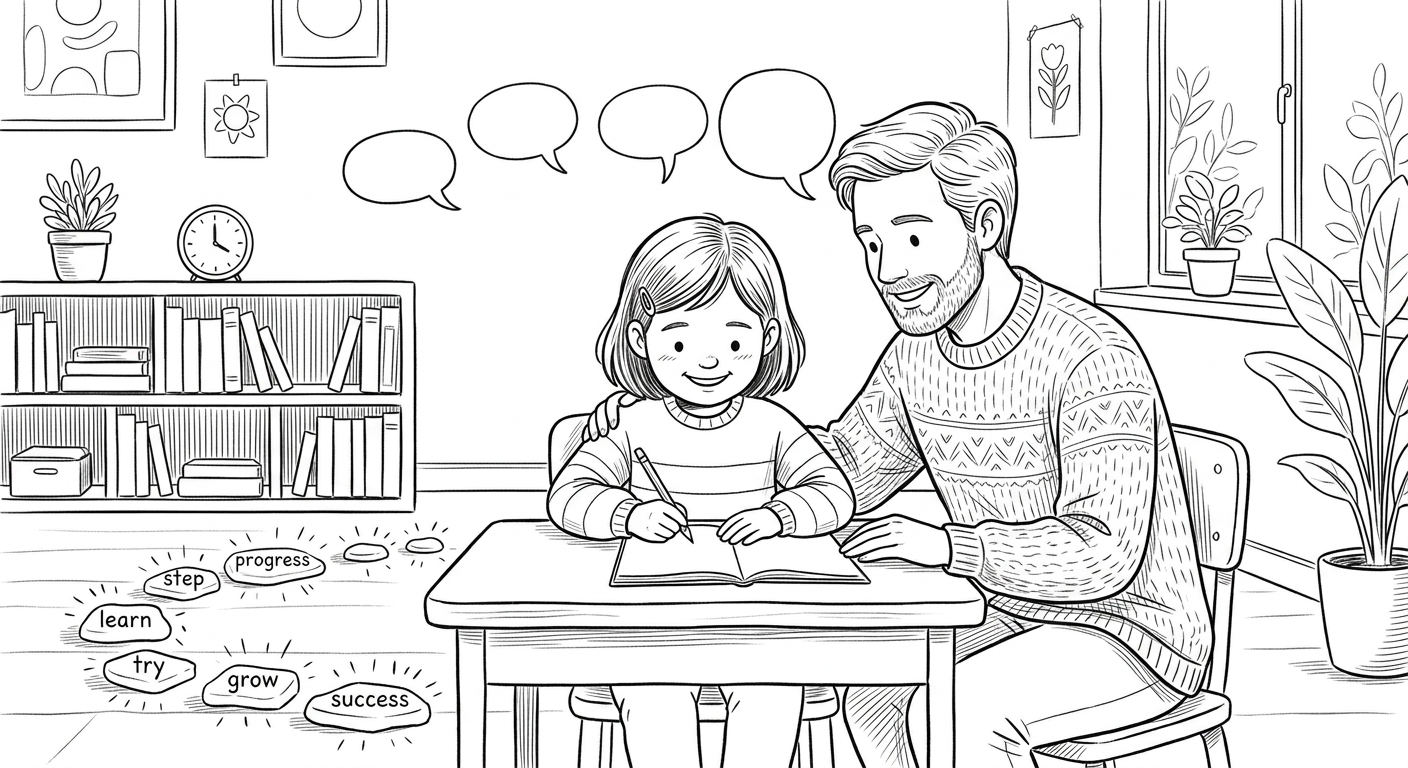
    Ein kleiner Erfolg kann etwas sehr Einfaches sein. Ein Kind schafft es, einen Satz fertig zu sagen, obwohl es zwischendurch stockt. Ein anderes versucht ein Wort noch einmal, nachdem es beim ersten Mal nicht funktioniert hat. Zwei Kinder geraten in einen Konflikt, aber statt sofort laut zu werden, bleibt ein Moment Zeit zum Reden.

    Von aussen betrachtet wirken solche Situationen oft unscheinbar. Sie gehen im Alltag fast unter. Für die betroffenen Kinder können sie jedoch eine grosse Bedeutung haben.

    Denn in diesen Momenten passiert etwas Entscheidendes: Ein Kind erlebt, dass etwas gelingt.

    Nicht perfekt. Nicht mühelos. Aber ausreichend.

    Diese Erfahrungen sind wichtig, weil sie langsam das Selbstbild verändern können. Wenn ein Kind merkt, dass etwas funktioniert, entsteht eine neue Möglichkeit zu denken: Vielleicht kann ich das doch.

    Diese Veränderung passiert selten plötzlich. Sie entwickelt sich leise, Schritt für Schritt. Ein bisschen mehr Mut, etwas zu sagen. Ein bisschen mehr Vertrauen in die eigenen Fähigkeiten. Ein bisschen mehr Geduld mit sich selbst.

    In der sozialpädagogischen Arbeit bedeutet das oft, den Blick bewusst auf diese kleinen Fortschritte zu richten. Nicht nur auf das, was noch schwierig ist, sondern auch auf das, was bereits gelingt.

    Das bedeutet auch, Erwartungen so zu gestalten, dass Erfolgserlebnisse möglich werden. Nicht indem man Anforderungen reduziert, sondern indem man Situationen schafft, die erreichbar sind. Situationen, in denen Kinder erleben können, dass sich Anstrengung lohnt.

    Manchmal sind es genau diese kleinen Momente, die langfristig den grössten Unterschied machen.

    Ein Satz mehr als gestern.

    Ein Versuch mehr als letzte Woche.

    Ein Konflikt, der etwas ruhiger endet als beim letzten Mal.

    Aus solchen Erfahrungen entsteht langsam etwas Grösseres: Vertrauen in die eigene Fähigkeit, Herausforderungen zu bewältigen.

    Vielleicht ist genau das eine der wichtigsten Aufgaben in der sozialpädagogischen Arbeit. Räume zu schaffen, in denen kleine Erfolge überhaupt möglich sind.

    Denn Veränderung beginnt selten mit grossen Durchbrüchen. Sie beginnt mit kleinen Schritten, die plötzlich zeigen: Es geht doch.

  • Small Successes

    Small Successes

    In social pedagogy, we often talk about big goals. Development. Independence. Progress. These concepts are important, but in the everyday reality of my work, change usually looks different.

    It starts small.

    I work with children in a boarding setting at a speech and language school. Many of these children have already experienced that things do not work for them in the same way they seem to work for others. Language can be difficult. Words do not always come easily. Sentences get stuck. Thoughts are there, but expressing them is not always simple.

    And that affects much more than just speech.

    When communication is difficult, misunderstandings happen more quickly. Frustration builds faster. Conflicts escalate more easily. A child might want to explain why they are angry or what felt unfair in a situation, but they cannot find the words to say it.

    In those moments, a feeling of helplessness can emerge.

    And from helplessness, reactions often follow that are difficult to understand from the outside.

    Some children withdraw. Others become loud or impulsive. Some try to avoid situations where they might have to speak. Behind many of these reactions lies the same core experience: communication can feel like a struggle.

    If a child repeatedly experiences that things do not work, something else slowly develops — the belief that it might be better not to try at all.

    This is where small successes become important.

    A small success can be something very simple. A child manages to finish a sentence even though they hesitate in the middle. Another child tries to say a word again after it did not work the first time. Two children get into a conflict, but instead of immediately shouting, there is a moment where conversation becomes possible.

    From the outside, these moments can seem insignificant. They pass quickly in the flow of everyday life. But for the children themselves, they can mean a great deal.

    Because in these moments something important happens: a child experiences that something works.

    Not perfectly.

    Not effortlessly.

    But well enough.

    These experiences matter because they slowly begin to change how a child sees themselves. When something works, even in a small way, a new thought becomes possible: maybe I can do this after all.

    This kind of change rarely happens suddenly. It develops quietly, step by step. A little more courage to say something. A little more trust in one’s own abilities. A little more patience with oneself.

    In social pedagogical work, this often means consciously paying attention to these small moments of progress. Not only focusing on what is still difficult, but also noticing what is already working.

    It also means shaping expectations in a way that allows success to happen. Not by lowering standards, but by creating situations that are achievable. Situations in which children can experience that their effort leads somewhere.

    Sometimes these small moments are the ones that make the biggest difference in the long run.

    One more sentence than yesterday.

    One more attempt than last week.

    A conflict that ends a little calmer than the last one.

    From experiences like these, something bigger slowly grows: trust in one’s ability to face challenges.

    Perhaps that is one of the most important tasks in social pedagogical work — creating spaces where small successes can happen at all.

    Because real change rarely begins with big breakthroughs.

    It begins with small steps that suddenly show: it is possible after all.

  • Wenn Energie nicht unendlich ist

    Wenn Energie nicht unendlich ist

    Lange Zeit habe ich – still und unhinterfragt – geglaubt, dass Energie etwas ist, das man immer noch ein bisschen weiter dehnen kann.

    Man ist müde, also zieht man durch.

    Man ist überfordert, also reisst man sich zusammen.

    Ausruhen kann man später.

    Diese Vorstellung ist überall. Sie steckt in unserer Arbeitskultur, in unserem Verständnis von Produktivität, Motivation und sogar Selbstfürsorge. Streng dich mehr an. Sei diszipliniert. Erhol dich am Wochenende.

    Doch dieses Narrativ zerbricht in dem Moment, in dem Energie endlich wird – auf eine Weise, mit der man nicht verhandeln kann.

    Vor einiger Zeit wurde bei einer mir sehr nahestehenden Person ME/CFS diagnostiziert. Zu erleben, was diese Diagnose bedeutet, war ernüchternd. Nicht nur wegen der Krankheit selbst, sondern auch wegen ihrer Unsichtbarkeit – und weil unsere alltäglichen Systeme kaum eine Sprache dafür haben.

    Gleichzeitig beschäftige ich mich immer mehr damit, mich selbst als neurodivergente Person besser zu verstehen. Und auch wenn die Erfahrungen unterschiedlich sind, wurde mir schnell klar:

    Es gibt eine gemeinsame Realität – begrenzte Kapazität.


    Der Irrglaube vom „einfach weniger machen“

    Oft sprechen wir über Energieprobleme, als wäre es eine Frage der Balance:

    „Mach halt ein bisschen weniger.“

    „Hör besser auf deinen Körper.“

    „Priorisiere anders.“

    Diese Ratschläge gehen von einem stabilen Ausgangspunkt aus. Sie setzen voraus, dass sich alles wieder einpendelt, wenn man genug Pausen macht.

    Für viele Menschen ist das nicht die Realität.

    Bei ME/CFS ist Energie nichts, was einfach „leer wird“. Sie kann komplett kippen, wenn eine unsichtbare Grenze überschritten wird. Und die Konsequenzen zeigen sich nicht immer sofort. Man kann sich im Moment noch „okay“ fühlen – und Tage später dafür bezahlen.

    Auch bei vielen neurodivergenten Menschen ist Kapazität endlich, nur auf andere Weise. Kognitive Belastung. Soziales Maskieren. Sensorische Überreizung. Entscheidungserschöpfung. Nach aussen wirkt alles funktional, während das innere System längst am Anschlag ist.

    In beiden Fällen geht es nicht um fehlende Motivation.

    Es geht um Systeme, die unbegrenzte Energie voraussetzen.


    Was fehlt: eine Sprache für Grenzen

    Eines der schwierigsten Dinge – sowohl bei chronischer Erkrankung als auch bei Neurodivergenz – ist nicht die Erschöpfung selbst, sondern das Fehlen einer gemeinsamen Sprache für Grenzen.

    Wie erklärt man, dass:

    • ein „Nein“ heute nichts Emotionales ist, sondern strukturell?
    • eine kleine Tätigkeit bedeuten kann, morgen gar nichts mehr zu können?
    • Ruhe kein Luxus ist, sondern Schadensbegrenzung?

    Ohne Sprache entsteht Schuld.

    Ohne Werkzeuge bleibt nur Raten.

    Ohne Verständnis bleibt nur Durchhalten.

    Und genau dieses Durchhalten richtet oft Schaden an.


    Ich habe angefangen, etwas zu bauen – nicht um zu reparieren, sondern um wahrzunehmen

    Ich bin jemand, der Dinge baut. Wenn ich etwas nicht verstehe, versuche ich es zu strukturieren. Wenn etwas chaotisch wirkt, versuche ich, es sichtbar zu machen.

    Im Moment arbeite ich an etwas – ruhig, vorsichtig – nicht weil ich glaube, dass Technologie chronische Erkrankungen oder Neurodivergenz „lösen“ kann, sondern weil ich glaube, dass sie helfen kann, Muster zu erkennen, bevor sie wehtun.

    Es geht nicht um Optimierung.

    Es geht um Erlaubnis.

    Die Erlaubnis, aufzuhören, bevor etwas kippt.

    Die Erlaubnis, Energie als endlich zu behandeln – nicht als persönliches Versagen.

    Die Erlaubnis zu sagen: „Das war genug“, ohne sich rechtfertigen zu müssen.

    Ich tue das, weil ich gesehen habe, wie zerstörerisch es ist, wenn Grenzen ignoriert werden – von Systemen, von Arbeitswelten, von gut gemeinten Erwartungen und von uns selbst.

    Und ich tue es, weil ich weiss, wie schwer es als neurodivergente Person sein kann, den eigenen inneren Signalen zu vertrauen, wenn die Welt einem ständig sagt, dass sie falsch sind.


    Es geht nicht darum, sanfter mehr zu leisten – sondern sicher weniger

    Das ist ein feiner, aber entscheidender Unterschied.

    Viele Werkzeuge wollen helfen, mehr zu schaffen, ohne auszubrennen.

    Was oft fehlt, sind Werkzeuge, die helfen, gar nicht erst auszubrennen – selbst wenn das bedeutet, weniger zu tun.

    Diese Verschiebung ist wichtig.

    Sie macht Ruhe zu einer Strategie.

    Sie macht Grenzen zu Information.

    Sie macht „energiearme“ Tage zu Daten – nicht zu Niederlagen.


    Ich habe keine fertigen Antworten – aber das Problem ist real

    Ich schreibe das nicht als Expert*in.

    Ich schreibe es als jemand, der langsam und manchmal schmerzhaft lernt, dass Energie nicht für alle gleich funktioniert – und dass so zu tun, als wäre sie es, echten Schaden anrichtet.

    Wenn dich das anspricht, bist du nicht kaputt.

    Und wenn nicht, hoffe ich trotzdem, dass es ein wenig Neugier und Empathie hinterlässt.

    Manche Menschen leben in einer Welt, in der sich Energie über Nacht auffüllt.

    Andere nicht.

    Es ist Zeit, dass unsere Werkzeuge – und unsere Erwartungen – das widerspiegeln.

  • When energy isn’t infinite

    When energy isn’t infinite

    For most of my life, I believed — quietly, unquestioned — that energy was something you could always stretch a little further.

    You get tired, you push.

    You feel overwhelmed, you power through.

    You rest later.

    That belief is everywhere. It’s baked into how we talk about work, productivity, motivation, even self-care. Try harder. Be disciplined. Recharge on the weekend.

    But that story breaks the moment energy becomes finite in a way you can’t negotiate with.

    Recently, someone very close to me was diagnosed with ME/CFS. Watching that diagnosis land was sobering in a way I wasn’t prepared for. Not just because of the illness itself, but because of how invisible it is — and how poorly our everyday systems understand it.

    At the same time, I’ve been learning to better understand myself as a neurodivergent person. And while the experiences are different, something clicked almost immediately:

    the shared reality of limited capacity.


    The myth of “just doing less”

    We often frame energy issues as a matter of balance:

    “Just do a bit less.”

    “Listen to your body.”

    “Prioritise better.”

    That advice assumes a stable baseline. It assumes that if you rest enough, things reset.

    But for many people, that’s not how it works.

    For people with ME/CFS, energy isn’t something you “run low on” — it’s something that can disappear entirely if you cross an invisible line. And the consequences don’t always show up immediately. You can feel “okay” in the moment and pay for it days later.

    For many neurodivergent people, capacity is just as real and just as fragile — but it drains in different ways. Cognitive load. Social masking. Sensory overload. Decision fatigue. You can look functional on the outside while your internal system is already maxed out.

    In both cases, the problem isn’t motivation.

    It’s systems that assume unlimited energy.


    What we’re missing: language for limits

    One of the hardest parts of both chronic illness and neurodivergence isn’t the fatigue itself — it’s the lack of shared language around limits.

    How do you explain to someone that:

    • today’s “no” isn’t emotional, it’s structural?
    • doing one small thing might mean doing nothing tomorrow?
    • rest isn’t a reward, it’s damage control?

    Without language, people default to guilt.

    Without tools, people default to guessing.

    Without understanding, people default to pushing.

    And pushing is often exactly what causes harm.


    I started building something — not to fix, but to notice

    I’m a builder by nature. When I don’t understand something, I try to map it. When something feels chaotic, I try to give it structure.

    I’m working on something right now — quietly, carefully — not because I think technology can solve chronic illness or neurodivergence, but because I think it can help us notice patterns before they hurt us.

    The goal isn’t optimisation.

    It’s permission.

    Permission to stop before things break.

    Permission to treat energy as finite — not failing.

    Permission to say, “This was enough,” without having to justify it.

    I’m building it because I’ve seen how devastating it is when limits are ignored — by systems, by workplaces, by well-meaning people, and by ourselves.

    And I’m building it because I know how hard it is, as a neurodivergent person, to trust your own internal signals when the world keeps telling you they’re wrong.


    This isn’t about doing more gently — it’s about doing less safely

    There’s a subtle but important difference.

    Many tools try to help you do more without burning out.

    What’s missing are tools that help you not burn out in the first place — even if that means doing less.

    That shift matters.

    It reframes rest as strategy.

    It reframes limits as information.

    It reframes “low energy” days as data, not defeat.


    I don’t have all the answers — but I know the problem is real

    I’m not writing this as an expert.

    I’m writing this as someone who’s learning — painfully, slowly — that energy is not universal, and that pretending otherwise causes real harm.

    If this resonates with you, you’re not broken.

    And if it doesn’t, I hope it still plants a seed of curiosity and empathy.

    Some people live in a world where energy refills overnight.

    Others don’t.

    It’s time our tools — and our expectations — reflected that.

  • Getting lost in the back alleys was how I truly found Japan

    Getting lost in the back alleys was how I truly found Japan

    Every trip starts with a list of places to see. My list for Japan was full of famous temples and busy intersections. I saw those places, and they were impressive. But the real trip began when I put the map away. The moments that stayed with me happened in the small, quiet streets that connect the major roads. It was in those alleys, away from the crowds, that I started to get a real sense of the country.

    These narrow streets have a life of their own. You can hear the city, but it sounds different, more distant. The constant roar of traffic softens to a low hum, replaced by smaller, closer sounds. A bicycle bell rings gently, and you can hear the sizzle of food from a tiny restaurant with only a few seats. Wires hang in complex webs above your head, tracing paths from one building to the next. Residents place potted plants outside their doors, adding touches of green to the concrete. It felt like I had stepped behind a curtain, into the real, everyday rhythm of the city.

    In these spaces, I found my waypoints. A small shop selling grilled squid. An old vending machine humming in the afternoon sun. A cat sleeping on a warm wall. These were not destinations on a map. They were small moments of discovery that made the whole experience feel personal. This is where people live their lives, and I was grateful to walk through it, even for just a moment.

    The feeling was different in each city. In Tokyo, the alleys felt like secret passages in a giant, modern machine. You could turn a corner from a street with towering glass buildings and find yourself in a place that felt a generation older. In Kyoto, the alleys were quieter and seemed to hold on to history. They led to peaceful gardens or homes with traditional wooden walls, making the city’s past feel very present.

    This is what I will remember most about my time in Japan. Not the famous landmarks, but the feeling of being on foot with no destination. It taught me that sometimes the best way to see a place is to get a little lost in it. You find things a guidebook can never show you. You find the simple, human details that make a place feel alive.

  • Why food matters at corporate events

    Why food matters at corporate events

    When you plan a corporate event, you focus on the big things like the guest list, speakers, and presentations. Food can sometimes feel like a minor detail. But the food you serve does more than just feed your guests. It plays a huge role in how people feel and what they remember. A great meal makes everyone feel comfortable and valued.

    Choosing the right menu shows your guests that you care about their experience. It sets the tone for the entire event, whether it is a formal conference or a casual team retreat. Thoughtful food choices can turn a standard business gathering into a memorable and positive occasion for everyone involved.

    Food creates connection

    Food brings people together in a natural way. At a corporate event, where networking is often a key goal, a shared meal provides a perfect opportunity for conversation. It gives attendees a reason to talk to each other in a relaxed setting. This helps build relationships that last long after the event is over.

    The way you serve food also shapes the atmosphere. For example, interactive food stations encourage guests to move around and mingle. A seated dinner creates a more formal and intimate environment. The right choice depends on your event’s goals, but either way, food acts as a social anchor that helps people connect.

    Food reflects your brand

    The food you offer at an event says a lot about your company. A creative and high-quality menu communicates excellence and attention to detail. It shows that your brand values quality in everything it does. This small detail can leave a big impression on clients, partners, and employees.

    On the other hand, a poor food experience can reflect badly on your brand. It might suggest a lack of care or a failure to plan properly. By investing in good food, you are investing in your company’s reputation. It is a simple but powerful way to reinforce your brand’s message and ensure your event is a true success.

  • The Ultrahuman Air Ring and Why I Like It

    The Ultrahuman Air Ring and Why I Like It

    I did not get the Ultrahuman Air Ring because I wanted more data. I already see enough numbers every day. What I wanted was something calm. Something that helps me understand my body without stressing me.

    The ring fits into my life very easily. It does not buzz, vibrate or interrupt me. I wear it, forget about it, and let it do its thing. That alone makes a big difference to me.

    What I like most about the Ultrahuman Air Ring is how it shows information. It does not tell me what to do. It does not push me to be better or more productive. It simply shows patterns. How I slept. How my body recovered. When I might have been more stressed. I look at the data later, when I have time and space for it.

    This is especially helpful for me because I am neurodivergent. When a device gives live feedback, it often creates pressure. I start to worry or try to fix things in the moment. With the ring, I can look back and understand my day instead of judging it.

    The ring also helps me be kinder to myself. When I feel tired or slow, I can see that my sleep was not great or that my body needed more rest. That makes it easier to accept low-energy days instead of fighting them.

    I also like that it is a ring and not a watch. It feels more private. Less visible. I do not feel like I am showing data on my body to the world. It just sits there quietly and blends into my day.

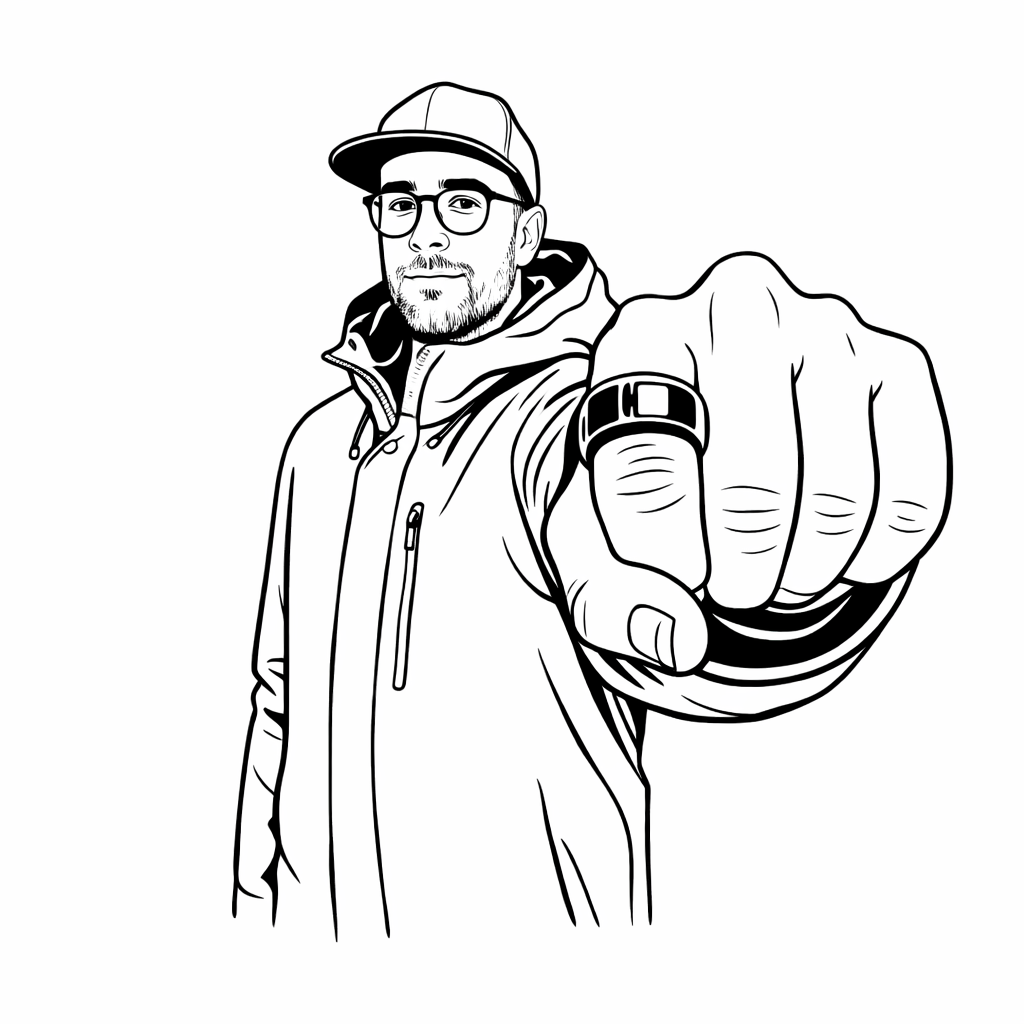
    Just because I like how this AI -Graphic turned out 🤪

    I do not use the Ultrahuman Air Ring to get perfect scores. I use it to notice patterns and to better understand myself. It helps me listen to my body instead of ignoring it.

    For me, good technology is calm technology. It supports me without taking over my attention. The Ultrahuman Air Ring does exactly that, and that is why I like it.

  • How to find the best photographer for your upcoming event

    How to find the best photographer for your upcoming event

    A great event deserves to be remembered, and photos are the best way to preserve those memories. Hiring a photographer is an investment in capturing the atmosphere, emotion, and important moments of your occasion. The images they create can be used for years in marketing materials, social media posts, and company archives.

    Finding the right person for the job can feel like a big task, but it does not have to be complicated. The key is to know what you are looking for and what questions to ask. With a clear plan, you can find a photographer who understands your vision and can deliver beautiful, professional images that tell the story of your event.

    Look for a style that matches your vision

    Every photographer has a unique style. Some specialize in formal, posed shots, while others excel at capturing candid, in-the-moment action. Before you start your search, think about the feeling you want your event photos to have. Do you want them to be polished and professional, or relaxed and documentary-style?

    Once you know what you want, start looking at portfolios. A photographer’s website and social media are great places to see their work. Look for examples from events similar to yours. If their style resonates with you and aligns with your brand, they might be a good fit.

    Discuss experience and professionalism

    Experience is about more than just taking nice pictures. A professional event photographer knows how to navigate a live event without disrupting it. They understand how to work with different lighting situations and how to anticipate key moments before they happen. Ask them about their experience with events of a similar size and scope to yours.

    Good communication is also essential. A professional photographer should be responsive, clear, and easy to work with. They should listen to your needs and be able to provide a clear contract that outlines their services, fees, and delivery timeline. This ensures there are no surprises and that you have a smooth working relationship from start to finish.

  • Rediscovering the simple joy of pizza made with a wood fire

    Rediscovering the simple joy of pizza made with a wood fire

    New York is a city of a million destinations. You can spend weeks here and feel like you have only scratched the surface. My plan was to see as much as I could. But the moment I will remember most from my trip happened by accident, on a side street in Brooklyn. I walked past a small pizzeria and the smell of woodsmoke stopped me. I went inside and found a reminder that the best things are often the most simple.

    The pizza arrived with a crust that was charred and bubbled from the intense heat. It had a slight crispness on the outside but was soft and light when I bit into it. This was a perfect base for the simple, fresh toppings. Nothing was complicated, yet everything tasted exactly as it should. It was the kind of food that forces you to slow down. In a city that is always moving, this meal felt like a quiet, necessary pause.

    A man worked behind the counter with a calm focus. He stretched the dough and added the toppings with an easy rhythm that you only get from doing something a thousand times. There was no wasted motion. It was a craft, a skill honed over years. He worked with a quiet confidence. He let the quality of his ingredients and the heat of his oven do the talking.

    The oven was the heart of the restaurant. Its warmth seemed to reach every corner and made the whole place feel welcoming. Looking at the fire inside, I understood that it does more than just cook. The flame is an ingredient. It is what gives the pizza its smoky flavor and its unique, leopard-spotted char. No other way of cooking can do what fire does. It is honest and it is powerful.

    For me, this pizzeria was more than just a place to eat. It was a connection to the real, everyday life of the city, away from the famous sights. It proved that a simple meal, made with care and with fire, can be the most memorable part of any journey. That is a joy worth looking for, especially in a city as big as New York.

  • The power of shared experience for team building

    The power of shared experience for team building

    Over my years as an event planner, I have seen firsthand what brings a team together. While traditional happy hours have their place, the most memorable and effective team-building events are the ones that break the mold. Moving beyond the expected shows your team that you are invested in their experience.

    I have found that the key is to create an environment where colleagues can interact in a new context. When people step out of their usual roles, they connect on a more personal level. This is where the real magic happens. It builds stronger relationships that carry back to the office, improving collaboration and overall morale.

    A creative workshop for a tech team

    Last year, I worked with a fast-growing tech company that wanted to do something different for their annual retreat. For this team of analytical thinkers, we decided to organize a hands-on wreath-making workshop. It was a simple, seasonal activity that encouraged everyone to get creative.

    The atmosphere in the room was amazing. People who normally spent their day coding were now sharing tips on arranging foliage and helping each other with design ideas. It was a low-pressure, collaborative experience that completely shifted the team dynamic. The client later told me it was the most engaged they had ever seen their team.

    A day of volunteering for a global firm

    For another client, a large financial firm, we planned a company-wide volunteer day. We partnered with a local organization to help rebuild a community garden. Instead of sitting in a conference room, executives and new hires were working side-by-side, getting their hands dirty for a good cause.

    The shared sense of purpose was powerful. It fostered a different kind of teamwork, built on encouragement and a common goal. The experience did more for team spirit than any formal training could. It reminded everyone that they were part of something bigger, both as a company and as a community.